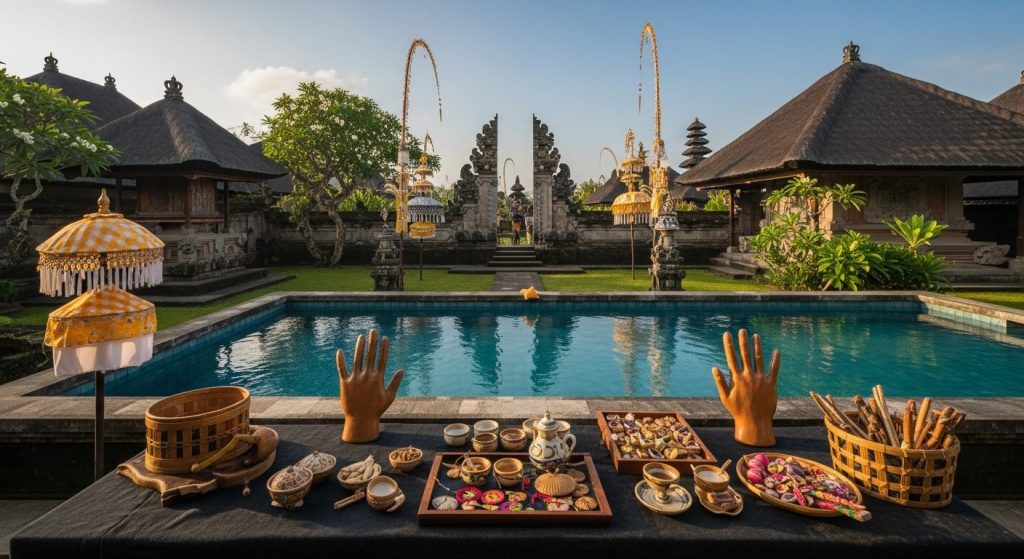
Private Bali cultural experiences are small-scale, privately guided encounters with Balinese village life, temple ritual and traditional craft, arranged for you and your party alone rather than as part of a coach group. At Bali Authentic Luxury we curate them as the genuine version of the island held to a five-star standard: real artisans at their workbenches, real ceremonies you take part in honourably, and real countryside, reached with a private guide and driver who knows the family, the priest or the weaver by name.
Bali is predominantly Hindu, unlike the rest of majority-Muslim Indonesia, and that faith shapes daily offerings, frequent temple ceremonies and the rhythm of village life. Most visitors only ever see a staged slice of this. The work we do is the opposite of the busloaded version: fewer people, more access, and the etiquette you need to be a welcome guest rather than a spectator.
What “authentic” actually means here
Authentic is an honest word that gets stretched until it means nothing. We use it narrowly. An experience earns the description when it is something Balinese people genuinely do, led by the people who actually do it, in a place that has not been rebuilt for tour traffic. A silver workshop in Celuk where the same family has hammered the same patterns for decades is authentic. A demonstration counter built to move groups through a showroom is not, however polished it looks.
There is no official Indonesian title called “authentic Bali curator,” and we will not pretend otherwise. “Authentic” and “luxury” are marketing descriptors, not regulated categories under Indonesian tourism law. What we offer is editorial knowledge plus introductions: we research and write these guides, then route your enquiry to vetted local guides, villages and temple-side hosts we trust. Our vetting is our own private process, not a government certification, and we say so plainly.
Private and curated versus busloaded and staged
| Dimension | Private cultural experience (curated) | Mass-tourism tour (staged) |
|---|---|---|
| Group size | Your party only, or a small intimate group | Coachloads on a fixed timetable |
| Where you go | Working villages, family compounds, active temples | Showrooms and viewing platforms built for volume |
| Who leads | A private guide who knows the artisan or priest personally | A guide reading a script to a microphone |
| Pace | You set it; time to talk, watch, ask | Set by the next bus arriving |
| Your role | A guest who takes part respectfully | An audience member at a performance |
| Etiquette support | Briefed in advance on dress, photography and conduct | Often minimal or absent |
Temple rituals you can take part in honourably
Bali’s temples are not museums; they are living places of worship where ceremonies happen constantly. Visiting one well means understanding that you are entering someone’s place of prayer. Two experiences are worth describing carefully, because both are sacred and both are widely misrepresented online.
Melukat, the purification ritual
Melukat is a Balinese Hindu purification ritual in which water is used to cleanse a person spiritually, often at a spring or water temple. It is a religious act, not a spa treatment, even when wellness marketing dresses it up as one. If you take part, you follow the instructions of the priest and your guide on the day: how to dress, how to enter the water, what offerings are involved and how to behave at each spring. We can route you to a guide and a temple where guests are genuinely welcomed for melukat, and we will brief you beforehand, but the conduct on the day belongs to the priest, not to us.
One honest note: this page is cultural and travel information, not religious or ritual instruction. We describe melukat so you arrive prepared and respectful. We do not teach the rite, and we do not present it as a guaranteed spiritual outcome.
Temple ceremonies and local blessings
Traditional Balinese dance and gamelan music are woven into temple ceremonies, and around Ubud some of these are also presented in curated cultural performances for visitors. A private experience lets you attend a smaller, more genuine gathering, sometimes a family temple ceremony or an anniversary at a village temple, where a local blessing may be offered. Whether a ceremony is open to guests depends entirely on the community and the occasion; some are private family matters and should be left undisturbed. A good local guide knows the difference, which is exactly why we route you to one rather than handing you a generic ticket.
Temple dress code and conduct, in plain terms
Getting the etiquette right is the single biggest thing that separates a welcome guest from an awkward one. None of this is complicated, and being prepared lets you relax into the experience.
- Sarong and sash
- A sarong covering the legs and a sash tied at the waist are standard temple dress for visitors. Many temples lend or rent them, but a private guide will usually bring proper ones so you are not improvising at the gate.
- Shoulders covered
- Cover your shoulders and avoid revealing clothing inside temple grounds.
- Menstruation rule
- By Balinese Hindu custom, women who are menstruating do not enter temple grounds. This is a respected local convention, not a judgement, and guides will quietly mention it in advance.
- Photography
- Ask before photographing people, priests or ceremonies. During an active blessing, put the camera down unless your guide says it is fine. Never use a worshipper as a backdrop.
- Position and height
- Do not stand higher than a praying priest, do not point your feet at shrines or people, and do not walk in front of someone who is praying.
- Quiet and offerings
- Step around the small daily offerings on the ground rather than over them, keep your voice low, and follow your guide’s lead on where it is appropriate to sit or stand.
If any of this feels like a lot to remember, it is precisely what a private guide handles for you. You arrive briefed; they manage the moment.
Planning a multi-generation trip or a honeymoon and want the cultural days mapped without over-scheduling? You can plan your bespoke Bali trip with us and we will shape a flow of days that leaves room to breathe. A short WhatsApp conversation is usually the easiest way to start.
Artisan and heritage encounters
Bali has long-standing clusters of artisans producing woodcarvings, woven baskets, batik and ikat textiles and silver jewellery, concentrated in and around Ubud and central and southern Bali. A private artisan day is one of the most rewarding ways to spend time here, because you watch real skill at close range and often leave with a piece made by the hands you just shook.
Celuk silver
Celuk is Bali’s silver-working village, known for fine granulation and filigree. In a private setting you sit with a silversmith, see the tools and the technique, and understand why a genuine handmade piece differs from factory stock. Some workshops will let you try a simple step under guidance.
Mas woodcarving
The village of Mas is central to Balinese woodcarving, where carvers work mask, deity and abstract forms from a single block. A private visit means time with a working carver rather than a sweep through a gallery, and a chance to understand the iconography behind the pieces.
Traditional textiles
Balinese and broader Indonesian weaving traditions, including batik and ikat, are slow, exacting crafts. A heritage textile visit can include watching a weaver at the loom or a batik artist working wax and dye by hand, with the story of the patterns and what they mean to the family producing them.
Village life and the rice-terrace landscape
Beyond craft, the most quietly memorable cultural experiences are often the simplest: a morning in a working village, a walk through the rice terraces, a conversation over coffee with a farming family. Bali’s countryside is not just scenery. The “Cultural Landscape of Bali: the Subak System as a Manifestation of the Tri Hita Karana Philosophy” has been a UNESCO World Heritage Site since 2012, covering subak-irrigated rice terraces and water temples in areas such as Jatiluwih and the Pakerisan watershed.
The subak is a traditional Balinese cooperative irrigation system organised around water temples and grounded in the Tri Hita Karana philosophy, a worldview about harmony between people, nature and the divine. High-end Bali itineraries often weave in these UNESCO-listed terraced landscapes precisely because they show the authentic, working backbone of Balinese culture rather than a built attraction. A private rice-terrace immersion at Jatiluwih, walked slowly with a guide who can explain the subak rather than just photographed from a viewpoint, is a different order of experience.
How we work, and how we are paid
We are an independent curator and editorial publisher. We do not own the temples, villages or workshops we describe, and we are not a party to every arrangement you make on the ground. What we do is research, write honestly, and introduce you to vetted local guides and hosts who deliver these experiences. You retain control; the cultural relationship is between you, your guide and the community.
On money, we are straightforward. If you proceed with a partner they may pay us a referral fee at no extra cost to you. That is the model. Prices for private cultural and artisan days vary widely by length, distance, group size and the experiences included, so we quote ranges only and always confirm current figures with the partner before you commit; the ranges discussed in any plan were last verified June 2026. Everything here is information and curation, not licensed travel, legal or religious advice.
Frequently asked questions
What are private Bali cultural experiences?
They are privately guided, small-scale encounters with Balinese culture, such as temple rituals, artisan visits and village or rice-terrace immersion, arranged for your party alone rather than as part of a large group tour. They are led by local guides who know the place and the people, with etiquette briefed in advance so you take part respectfully.
Can tourists take part in a melukat purification ritual?
Yes, at temples and springs that welcome guests, melukat can be experienced with a proper guide and the permission of the priest. Melukat is a Balinese Hindu purification ritual, so you follow the instructions of the priest and your guide on the day regarding dress, conduct and offerings. We can route you to a suitable guide and temple and brief you beforehand, but the ritual conduct belongs to the priest, and this is cultural information rather than religious instruction.
What is the dress code for visiting a Balinese temple?
Wear a sarong covering your legs and a sash tied at the waist, and keep your shoulders covered. By local custom, menstruating women do not enter temple grounds. A private guide typically provides proper sarongs and sashes and briefs you on photography, positioning and quiet conduct before you arrive.
How is this different from a standard group tour?
A standard tour usually moves coachloads through showrooms and viewing platforms on a fixed timetable. A curated private experience takes your party only into working villages, family compounds and active temples, led by a guide who knows the artisans or priest personally, at a pace you set, with etiquette handled for you.
Do you charge for cultural experiences, and how are you paid?
We curate the information and introductions; the experiences are delivered by vetted local partners. If you proceed with a partner they may pay us a referral fee at no extra cost to you. We quote price ranges only and confirm current figures with the partner before you commit.
Start planning your cultural days
If you want Bali’s real culture held to a five-star standard, with the temple etiquette, artisan access and village time handled carefully and respectfully, tell us who is travelling and what draws you. We will shape the cultural side of your itinerary around it. You can plan your bespoke Bali trip here, or send the same details over WhatsApp and we will reply with honest, specific suggestions and the right local people to introduce you to.